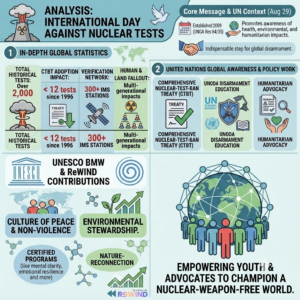
On 29 August every year, the world observes one of the most horrific tragedies of the twentieth century. The International Day Against Nuclear Tests was established by the UN General Assembly resolution 64/35 of 2009. This day was set to commemorate the closure of the Semipalatinsk test site in Kazakhstan on 29 August 1991. The International Day Against Nuclear Tests seeks to remember the victims of nuclear tests and promote a culture of peace by striving towards a world free of nuclear weapons.
Hiroshima and Nagasaki
The first atomic bombs were exploded over Hiroshima and Nagasaki, destroying these cities on 6 August 1945 and 9 August 1945. Atomic bombs were first tested in the United States on 16 July 1945 in New Mexico. In Hiroshima and Nagasaki, approximately 140000 people died in the attack and the following radioactive aftermath, whereas in Nagasaki, the number of fatalities accounts for 70000-74000 people. However, even though the majority of the victims of nuclear tests were among the hibakusha, the term also refers to those who were exposed to radiation from the explosion and survived it. Atomic bombing resulted in numerous health issues, such as leukemia, cancer, cataracts, and other radiation-induced diseases. Moreover, the effects of nuclear testing may last for decades after exposure, posing significant risks for future generations of those who survived the tests. The use of atomic weapons was the only time in human history that nuclear weapons were used, and it remains evident that there are no acceptable reasons for engaging in any nuclear tests.
Detrimental Effects of Nuclear Testing
Over two thousand nuclear tests were carried out between 1945 and the late 1990s. These tests were conducted in many different environments, ranging from deserts and atolls to steppes and mountains. Roughly a quarter of nuclear tests conducted involved detonating the weapons in the atmosphere, whereas the rest took place underground. Nuclear testing often had profoundly adverse environmental consequences, such as the “tired mountain syndrome,” which occurs when geological faults on mountainous terrain are subjected to stress from underground nuclear explosions. Other environmental consequences of nuclear tests involve the contamination of groundwater and soil, which can last for decades after the tests. Nuclear testing also brought severe consequences for the indigenous people who inhabited the territories where tests were conducted. They included severe health damage, significant disruption of their traditional way of life, loss of land, and even famine. The rates of cancer, birth defects, miscarriages, and other severe conditions were severely increased. The long-term consequences of nuclear testing affect not only the people but also the environment and food resources.
Moratoria and the Imperative Ensured
Since 1996, the Comprehensive Nuclear-Test-Ban Treaty Organization has worked to establish a worldwide ban on nuclear testing. Despite the international consensus on the devastating effects of nuclear tests, there have been several violations of the test-ban treaties, including three official tests conducted by India and Pakistan in 1998 and several tests conducted by the DPR Korea, which officially withdrew from the treaty in 2003. It is essential to continue working towards global efforts in banning nuclear tests because warfare, in general, and nuclear warfare, in particular, is not an option for a prosperous future. Continuing nuclear tests only serve to increase the number of horrifying and horrifying acts of violence that humanity has already witnessed.
UNESCO BMW’s Role
UNESCO Body and Mind Wellness Club (UNESCO BMW), in its capacity as an organization devoted to maintaining peace and promoting environmental sustainability, as well as ensuring education for young people about the importance of harmony between nature and humankind, contributes to the culture of peace by raising awareness of the International Day Against Nuclear Tests and educating youth on the importance of a world free from nuclear weapons so that it is underscored that a nuclear-free world equals to a more peaceful and just one.
By Ruheena Roushanara Choudhury
Bibliography:
https://www.un.org/en/observances/end-nuclear-tests-day/history
https://www.icanw.org/nuclear_tests
https://www.nkhiddengulag.org/blog/human-security-risk-tired-mountain-syndrome
https://ourworldindata.org/grapher/number-of-nuclear-weapons-tests