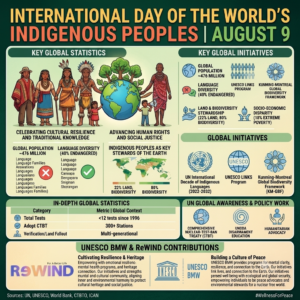
Every 9 August, the international community celebrates the International Day of the World’s Indigenous Peoples. Established by the United Nations General Assembly in 1994 (resolution 49/214), the Day commemorates the first meeting, in 1982, of the United Nations Working Group on Indigenous Populations. The UN General Assembly resolution 49/214 recognized the need to promote appropriate measures that contribute to strengthening respect for indigenous cultures and awareness of the rights of indigenous peoples to their lands and traditional ways of life.
Indigenous Cultures Around the World
Around 90 countries are home to more than 476 million indigenous people who represent more than five thousand cultures and speak most of the world’s 7,000 languages. These people live in a wide range of environments, from the polar regions to the tropical forests, from the Pacific islands to the Andean highlands and beyond. There is great diversity in ways of life and relationships with the natural environment among the world’s indigenous peoples. For example, at least a quarter of the world’s ice-free land area is managed by Indigenous Australians, Asians, and Native Americans.
How the Indigenous Peoples Have Made the World Better
In addition, there are many traditional knowledge systems that provide solutions to contemporary problems, such as climate change, food security, and conservation, and thus serve as examples for other civilizations. Using traditional knowledge and practices, indigenous peoples and local communities can make meaningful contributions to the conservation and sustainable use of biodiversity and the mitigation of climate change. For instance, the world’s forests store at least 25 percent of carbon found in the atmosphere, while indigenous forestlands contain more than half of that amount. Moreover, many traditional practices, such as those used by indigenous midwives, are often found to be effective and efficient and are increasingly being adopted by conventional medicine.
UNESCO BMW’s Role
By promoting education, cultural exchange, and environmental sustainability in accordance with UNESCO’s mission to maintain peace and sustainable development through mutual understanding among civilizations and respect for humanity’s diversity, the Club highlights the importance of Indigenous knowledge systems, cultures, and peoples. In doing so, UNESCO BMW encourages youth to learn about indigenous cultures and traditions, thereby supporting peacebuilding, sustainable development, and intercultural dialogue at the local and global levels.
Indigenous Knowledge for a Sustainable Future
Thus, on the day of commemorating the first meeting of the United Nations Working Group on Indigenous Populations, the Club invites you to listen closely to the wisdom of the world’s oldest cultures. The traditional knowledge of different Indigenous Peoples and Nations is invaluable for building a sustainable future for humanity.
By Ruheena Roushanara Choudhury
Bibliography
https://www.un.org/en/observances/indigenous-day
https://www.unep.org/news-and-stories/story/tapping-indigenous-knowledge-protect-nature
https://stories.undp.org/10-things-we-all-should-know-about-indigenous-people