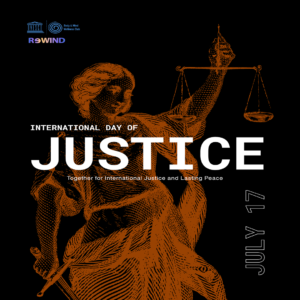
World Day for International Justice: Together for International Justice and Lasting Peace
Some crimes are too serious to be prosecuted in a single country. Crimes against humanity, war crimes, and genocide transcend national boundaries, outlive governments, and can leave victims with no recourse. Every year on July 17, the globe observes Globe Day for International Justice to remind people that there is, at least in theory, a mechanism in place to close that gap and to rekindle the international commitment required to maintain it.
The Background of International Justice Day
The day honors the July 17, 1998, approval of the Rome Statute, the foundational agreement that created the International Criminal Court (ICC). The International Criminal Court (ICC) was established as the first permanent international court to prosecute people for the most serious crimes under international law—genocide, war crimes, crimes against humanity, and crimes of aggression—rather than governments. The Day of International Criminal Justice, also known as International Justice Day or World Day for International Justice, was officially declared by the Assembly of States Parties in 2010 at the Rome Statute Review Conference in Kampala, Uganda. The observance was first observed in 2003.
Why the Day Still Matters
International Justice Day is both a celebration and a call to action. It acknowledges the role of civil society in holding ICC member states accountable to their obligations and calls on governments that have committed to the Rome Statute system to continue supporting it in practice rather than merely on paper. In order to increase public awareness of how international justice actually functions and why it is still vulnerable, coalitions, courts, and advocacy organizations around the world commemorate the day annually with panels, exhibitions, and public events. These events are frequently held at establishments like the ICC in The Hague or the United Nations headquarters.
Progress and Persistent Challenges
International justice has a truly uneven track record. In addition to applying legal pressure on matters like carbon emissions linked to climate change, international tribunals have assisted in resolving actual conflicts, such as the conflict between East Timor and Indonesia that aided East Timor’s journey to independence. However, the system has well-known limitations: the International Criminal Court (ICC) has a police force of its own and cannot force governments to uphold its decisions. As a result, some condemned individuals are still free, and several disputes that the court was supposed to assist in resolving continue unresolved. It is precisely because of this discrepancy between the promise of international justice and its real enforcement capacity that it is still important to continue drawing attention from around the world, as this day is intended to do.
UNESCO BMW and the ReWIND Project
In honor of World Day for International Justice, UNESCO Body & Mind Wellness Club (UNESCO BMW) uses print and social media to raise awareness of the international court system’s inadequacies as well as its accomplishments. UNESCO BMW’s free ReWIND program, an eight-session course that has already reached over 500 participants, including 32 teenagers and 70 adults, is linked to this same goal of reestablishing peace and order. It provides people with useful tools to manage stress, anxiety, and anger—the same underlying tensions that, if left unaddressed at a societal level, frequently fuel the very conflicts international justice is designed to address.