The Origin
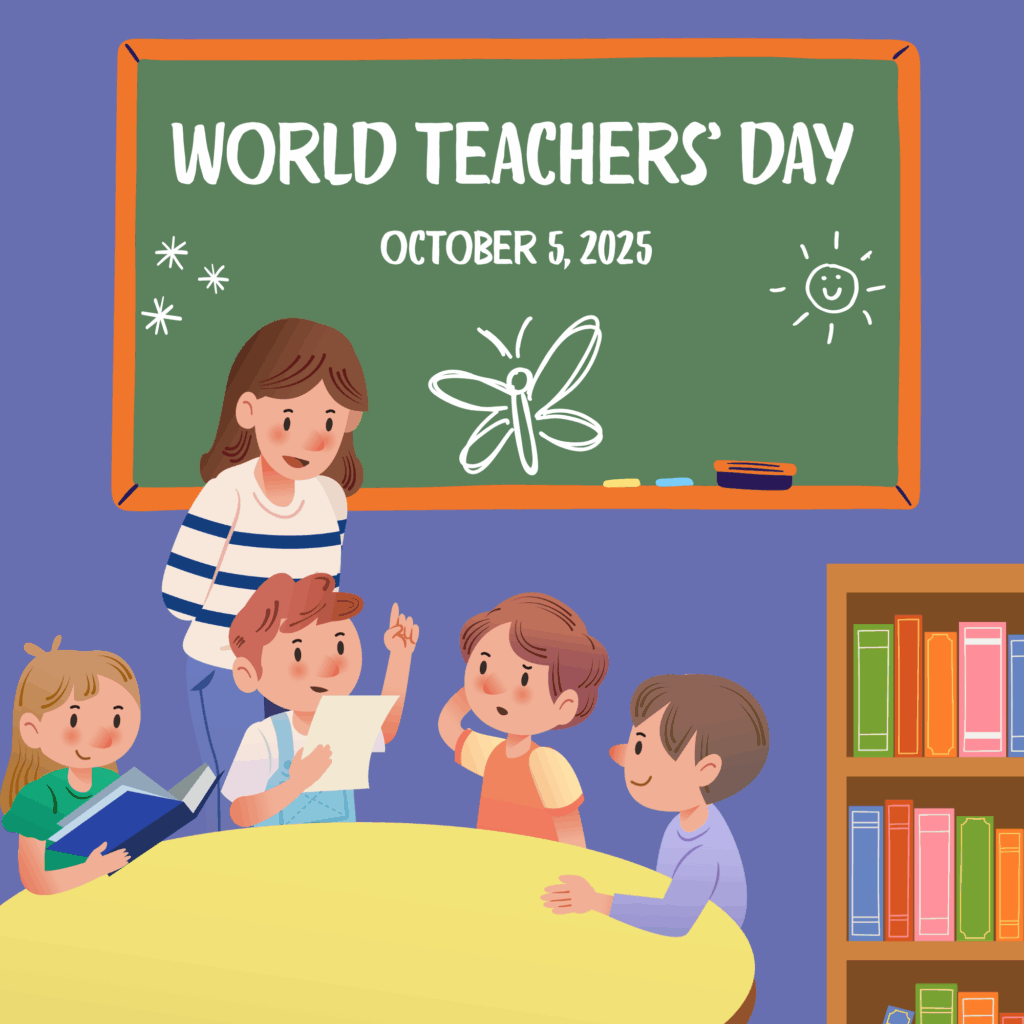
World Teacher’s Day, observed every year on October 5, is not just a symbolic date but a celebration of one of humanity’s oldest and most respected professions. It was established by UNESCO in 1994, marking the anniversary of the 1966 ILO/UNESCO Recommendation concerning the Status of Teachers, a landmark framework that set global standards for teachers’ rights, responsibilities, and working conditions. This recommendation recognized teaching not merely as a profession but as a cornerstone for peace, social progress, and human dignity.
From ancient times, societies have relied on teachers in various forms—gurus, mentors, philosophers, elders—to pass down knowledge, values and skills. Whether in small villages or global metropolises, the role of the teacher has always been the same: to illuminate minds, guide hearts and shape futures.
Importance of the Day
Why dedicate an entire international day to teachers? The answer lies in the fact that teaching is not just about academics. Teachers help children discover their voices, inspire creativity and plant seeds of kindness and empathy. They also shoulder heavy responsibilities, coping with inadequate resources, managing overcrowded classrooms, adapting to new technologies and in many cases, teaching in contexts of crisis and conflict.
World Teacher’s Day is a chance to acknowledge their resilience, advocate for better policies, and ensure teachers receive the support and respect they deserve. As UNESCO emphasizes, no education system is better than its teachers. The stronger and more supported the teachers, the stronger the foundation of society.
Teachers in Today’s World
In today’s rapidly changing world, teachers face both exciting opportunities and unique challenges. The digital revolution has brought about new methods of learning, yet it has also widened the digital divide. Many teachers in underprivileged communities struggle to teach without access to reliable electricity, internet, or even basic supplies. At the same time, the COVID-19 pandemic revealed teachers’ ability to adapt and innovate—switching to online classes almost overnight to ensure learning never stopped.
Moreover, teachers are not only academic guides but emotional anchors. They often notice when a child is struggling at home, when a student needs encouragement or when someone has potential waiting to be nurtured. Their role extends far beyond textbooks—they are protectors, motivators and role models.
Humanize Touch: Stories of Impact
Imagine a young girl in a rural village who dreams of becoming a doctor. Without her teacher walking several miles each day to reach the small school, she might never have learned the basics of science and math. Or think of the student in an urban city who almost dropped out because of self-doubt, but a teacher’s encouragement helped him graduate and pursue higher studies.
These stories are not isolated—they are the daily reality of millions of classrooms worldwide. Behind every scientist, artist, engineer or leader stands a teacher who believed in them. This is the human power of teaching: it does not just transfer knowledge, it transforms lives.
UNESCO BMW’s Involvement
UNESCO BMW recognizes the vital contribution of teachers in building not only intellectual capacity but also emotional well-being. Through initiatives such as the ReWIND program, we encourage educators to focus on mental health balance, and creativity. By hosting workshops and campaigns, UNESCO BMW ensures that teachers find inner peace, enabling them to give their best to students.
Supporting teachers is not just about training; it is about honoring them as the backbone of communities. By empowering teachers, we invest directly in a peaceful, sustainable and compassionate future for all.
Conclusion
World Teacher’s Day is more than an event on the calendar—it is a reminder to celebrate those who light the path for humanity. Teachers are not only carriers of knowledge but builders of dreams, defenders of justice and guardians of peace. On this October 5, let us commit to valuing, respecting and supporting our teachers, for they truly hold the keys to the world’s future.
By: Jannatul