The Origin
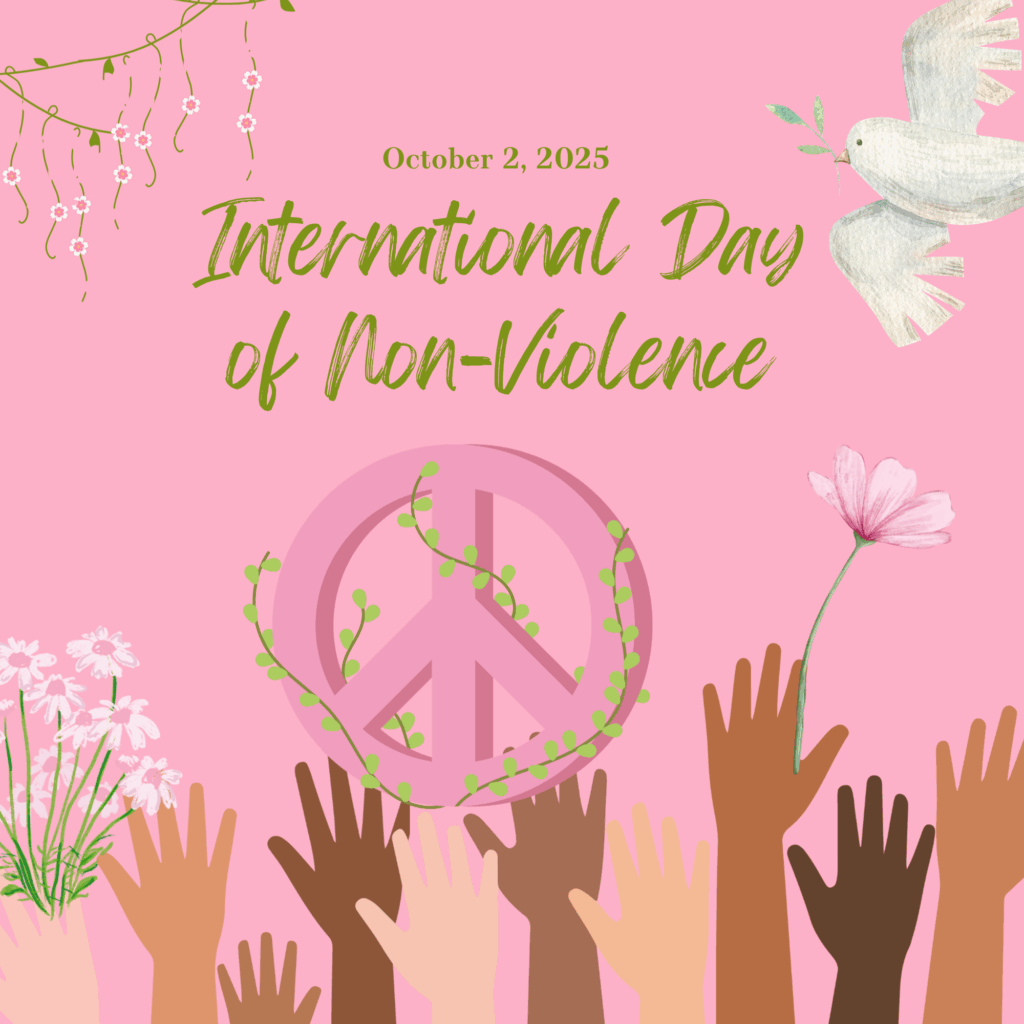
The International Day of Non-Violence is observed annually on October 2, coinciding with the birthday of Mahatma Gandhi, the leader of India’s independence movement and an enduring symbol of peace and justice. The United Nations General Assembly established this observance through Resolution A/RES/61/271 on 15 June 2007, after a proposal that gained momentum from grassroots voices, Nobel laureates and global leaders.
The idea originated when Nobel Peace Prize laureate Shirin Ebadi brought forward a proposal from a Hindi teacher in Paris at the World Social Forum in Mumbai in 2004. The call for a day dedicated to non-violence gathered momentum, culminating in the Satyagraha Conference in New Delhi in January 2007, led by Indian National Congress President Sonia Gandhi and Archbishop Desmond Tutu. The resolution eventually received support from 140 co-sponsoring nations, symbolizing the universal relevance of Gandhi’s vision.
In introducing the resolution, India’s Minister of State for External Affairs, Mr. Anand Sharma, invoked Gandhi’s own words: “Non-violence is the greatest force at the disposal of mankind. It is mightier than the mightiest weapon of destruction devised by the ingenuity of man.” This spirit continues to shape the day’s observance worldwide.
Importance of the Day
The International Day of Non-Violence serves as a reminder of the timeless relevance of Gandhi’s teachings. Gandhi, who led India’s struggle for independence through peaceful means, demonstrated that just means lead to just ends. His campaigns, including the Salt March of 1930, embodied the principle that violence and hatred cannot lay the foundation of a peaceful society.
Non-violence, also known as non-violent resistance, rejects physical violence in favor of social and political transformation through peaceful struggle. This principle has inspired countless global movements for civil rights, democracy and social justice. From Martin Luther King Jr.’s leadership in the United States to Nelson Mandela’s struggle against apartheid, Gandhi’s methods continue to prove that ordinary people can achieve extraordinary change without resorting to arms.
The UN General Assembly resolution emphasizes the universal relevance of non-violence and calls for a culture of peace, tolerance, and understanding. It urges governments, organizations, and citizens worldwide to use the day to promote education and public awareness about peacebuilding and non-violent solutions to conflict.
Theme for 2025
The theme for International Day of Non-Violence 2025 is expected to be framed around the global call: “Say No to Violence: Building Institutions of Peace.” Inspired by Secretary-General António Guterres’ words, “Together, let’s build institutions to support that noble vision,” the 2025 observance emphasizes strengthening systems, laws and communities that uphold non-violence as a guiding principle.
This theme encourages nations to move beyond rhetoric, focusing instead on creating sustainable frameworks that prevent conflict, address inequality and foster dialogue. It highlights how non-violence is not merely an individual ethic but a collective responsibility, requiring institutions that reflect justice, accountability and inclusivity.
UNESCO BMW’s Involvement
The UNESCO Body and Mind Wellness (BMW) initiative actively supports the International Day of Non-Violence by integrating Gandhi’s principles into its educational, cultural, and wellness programs. In 2025, UNESCO BMW is set to organize awareness campaigns, digital storytelling initiatives and collaborative dialogues with youth leaders across continents.
Through its focus on holistic well-being, UNESCO BMW emphasizes that non-violence is not only the absence of conflict but also the presence of harmony, within individuals, communities, and institutions. Activities will include:
- Educational workshops to promote the philosophy of non-violence in schools and universities.
- Community dialogues to strengthen intercultural understanding and reduce hate speech.
- Mindfulness and wellness practices that cultivate inner peace, essential for non-violent social engagement.
- Collaborations with governments and NGOs to integrate non-violence into peace education curricula.
UNESCO BMW’s presence ensures that the observance of October 2 moves beyond symbolic tribute and becomes a platform for tangible action.
UNESCO BMW’s Vision
UNESCO BMW envisions a world where non-violence is not just a response to conflict but a proactive way of life. Guided by Gandhi’s conviction that “non-violence is the greatest force available to humanity,” the initiative seeks to:
- Promote education for peace, thereby ensuring that young people grow up with the values of tolerance, dialogue, and empathy.
- Strengthen resilient communities by fostering cooperation, cultural exchange and inclusivity.
- Advance holistic wellness, recognizing that personal well-being contributes to social harmony.
- Build institutions of peace, advocating for governance structures and policies rooted in fairness, justice and non-violent problem-solving.
By combining Gandhi’s philosophy with modern frameworks of education and wellness, UNESCO BMW works toward a global culture where peace is not an exception but the norm.
By: Apurva Divakaran