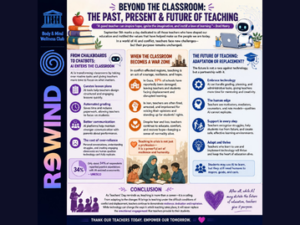
Brad Henry once said, “A good teacher can inspire hope, ignite the imagination, and instill a love of learning.” September 5th marks a day dedicated to all those teachers who have not only shaped our education but also instilled the values that have helped make us the people we are today. In this developing world of AI and technological innovation, the role of the teacher is increasingly being questioned and, at times, overlooked. While artificial intelligence is transforming classrooms and the careers of educators, teachers in war-ridden regions such as Iran face an entirely different reality, struggling to keep education alive. UNESCO suggests that only about 34% of respondents reported positive experiences with AI-assisted assessments, showing that AI is creating opportunities but also uncertainty for educators. This raises a particularly important question for the world- where does this leave the teacher who once stood at the heart of the classroom?
From Chalkboards to Chatbots: AI Enters the Classroom
The answer is not that teachers are disappearing, but that their roles are evolving.AI has its own share of benefits that it gives to teachers, such as helping to curate lesson plans, automated grading, which saves time and paperwork for teachers, rs and also maintaining better communication with parents regarding their child’s performance. However, this growing reliance on technology can come at a cost. Personalised conversations, understanding a student’s difficulties, and creating an engaging classroom are aspects of teaching that technology cannot fully replicate; hence, the overtaking of AI immensely creates a danger to teachers’ careers, as it raises concerns about the extent to which technology is replacing educators.
This contrast highlights the unequal realities of education around the world. In one part of the world, a teacher may be asking how AI can improve a lesson; in another, a teacher may be asking whether there will even be a classroom in which to teach tomorrow. On one hand, some teachers are adapting to the methods of integrating modern resources in education, while on the other, teachers in conflict-affected areas are fighting to keep education alive.
When the Classroom Becomes a War Zone
In regions affected by ongoing wars such as Gaza, attending schools can be mentally draining and overwhelming for children while they face the harsh conditions. Amidst all this, the superheroes of education put on a brave face,e showing remarkable courage as they continue to teach their students and create a sense of comfort for children whose lives have been disrupted bconflictic, making teaching not just a profession but a powerful act of resilience. A report states that “In Gaza, 97% of schools have reportedly been damaged”, leaving teachers and students facing displacement and severely disrupted learning. For educators, the challenge extends beyond the classroom as they must navigate their own hardships while simultaneously supporting students experiencing fear and loss.In Iran, the situation with teachers is also difficult, as they are often fired and even face arrest and jail time for voicing their opinions and views on the rights of their students. Although the context is different from Gaza, the essence is the same, as in both places, teachers are deprived of their rights to teach and express their opinions freely. However, even in the face of such adversity, they still strive to teach and help the youth acquire knowledge.
In these crisis-affected regions, teaching is still a means of restoring hope and resilience. By educating the children amidst all the repression and dislocation taking place, teachers can ensure some semblance of normality. This proves that educators constantly adapt to changing situations far beyond the syllabus reaffirming their role as an indispensable pillar of society.
The Future of Teaching: Adaptation or Replacement?
The future of teaching may not be a race against technology, but rather a partnership with it. Teachers must adapt to technological advances, using tools to assist with grading, planning, and administrative tasks so they can focus more on mentoring students and developing creative learning experiences. However, this raises an important question: if technology can replace many traditional responsibilities, what makes teachers necessary? A teacher is not simply a dispenser of information, but also a motivator, mediator, and mentor. They recognise when a student is struggling, know how to encourage them after failure, and create an environment where students feel comfortable learning. Therefore, the teachers who adapt to technology rather than resist it are likely to thrive. Technology can reduce the repetitive demands of teaching while allowing educators to focus on the human aspects of education that technology cannot easily replicate. The future of teaching is therefore not necessarily about replacing teachers, but about empowering them to teach more effectively.
UNESCO BMW’s Involvement in Teacher’s Day – ReWIND
As part of Teacher’s Day, UNESCO Body & Mind Wellness Club contributed through its ReWIND programme, which focuses on mental and emotional well-being, self-awareness, and managing everyday stress. The initiative highlighted that supporting teachers extends beyond professional development; their well-being is equally important. Through mindfulness and wellness activities, ReWIND provided an opportunity for teachers to pause from their responsibilities, reflect on their well-being, and develop healthier approaches to managing stress. This reinforced the idea that creating a positive educational environment requires caring not only for students, but also for the educators who guide them.
Conclusion
As Teachers’ Day rolls around, it is crucial to understand that teaching is about much more than just a career. From adapting to the changes AI brings to teaching under the difficult conditions of conflict and displacement, teachers continue to demonstrate resilience, dedication, and inspiration. While technology can change how teaching takes place, it will never be able to replace the emotional engagement that teachers provide to their students. It is perhaps in this light that one must appreciate Teachers’ Day by recognising more than just the teachings of our teachers, but the strength and dedication inherent to the profession. “After all, while AI may dictate the future of education, teachers give it purpose.”
Bibliography
- UNESCO.org
- ResearchGate
- https://pmc.ncbi.nlm.nih.gov/articles/PMC13059261/
- EFOS
- unescobmw.org